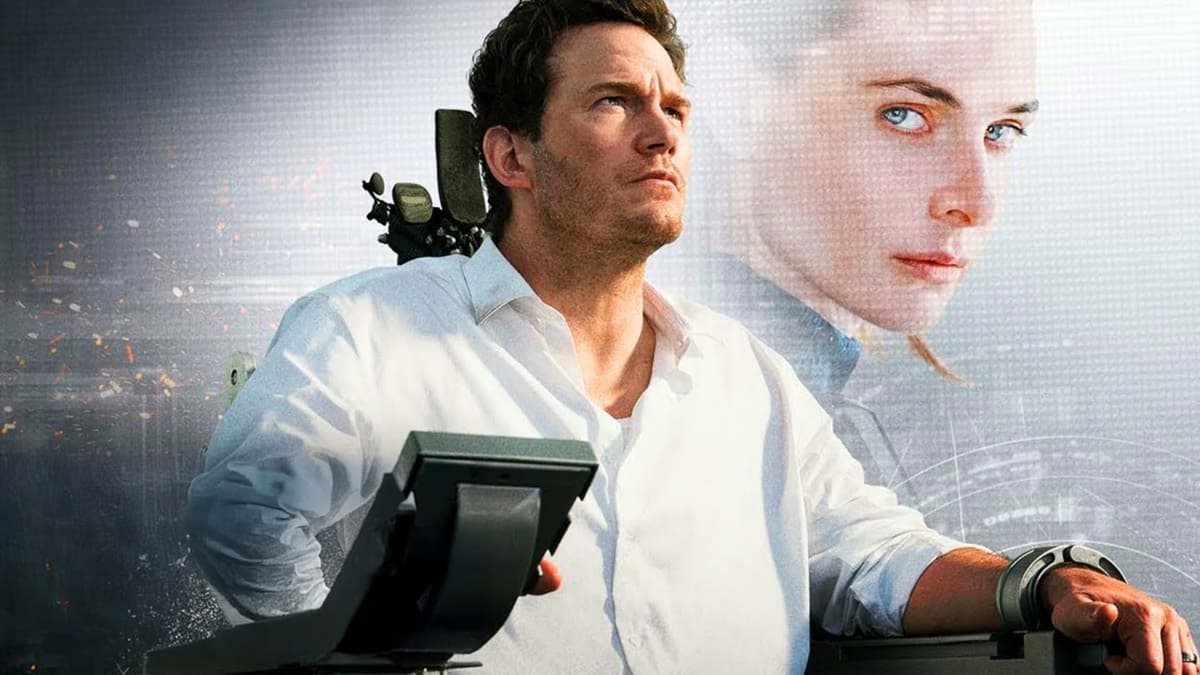
More than entertainment, the film directly dialogues with current discussions in Brazil and around the world, where the use of automated technologies is already beginning to influence judicial decisions, risk analyses, and public policies.
The Plot of Artificial Justice: Real-Time Trial and Race Against Time
The story follows Chris Raven, a Los Angeles police detective who finds himself in an extreme situation: accused of murdering his own wife, he must prove his innocence in just 90 minutes.
The trial takes place within a system called Mercy, an advanced artificial intelligence platform that acts as judge, jury, and executioner. Controlled by the AI Maddox, the system analyzes evidence, calculates probabilities, and determines guilt based on data.
The most disturbing detail is that in this universe, the logic of justice has been inverted: the defendant is considered guilty until proven innocent. If the probability of guilt exceeds a certain threshold, the sentence is executed immediately.
This concept creates a tense and dynamic narrative, marked by:
Real-Time Investigation
Chris must revisit evidence, access digital records, and reconstruct events while the clock ticks.
Massive Use of Technology
Cameras, cloud data, phone calls, and analytical intelligence are used as primary defense tools.
Psychological Pressure
Without a lawyer and with limited time, the protagonist depends solely on his own investigative ability.
AI in the Judicial System: Fiction or Near Reality?
Despite its futuristic tone, the film raises an extremely current question: to what extent can we trust algorithms to make decisions that directly impact people's lives?
In Brazil, for example, judicial bodies already use artificial intelligence-based systems for:
Case screening
Identification of legal patterns
Analysis of precedents
Automation of simple decisions
The National Council of Justice (CNJ) has encouraged the use of technology to increase system efficiency, but always emphasizes the need for human oversight.
What Artificial Justice does is take this trend to the extreme — showing a scenario where technology not only assists but completely replaces human judgment.
Inevitable Comparisons with Minority Report
It is impossible to watch the film without remembering Minority Report (2002), starring Tom Cruise. As in that work, technology is used to anticipate or determine crimes, raising profound ethical questions.
However, there are important differences:
In Minority Report: Technology predicts crimes before they happen.
In Artificial Justice: AI judges crimes already committed based on probabilities.
Both, however, share a central point: the risk of blindly trusting systems that, despite being advanced, are still subject to failures.
Strengths of Artificial Justice
Even without reinventing the genre, Artificial Justice presents qualities that sustain the viewer's experience.