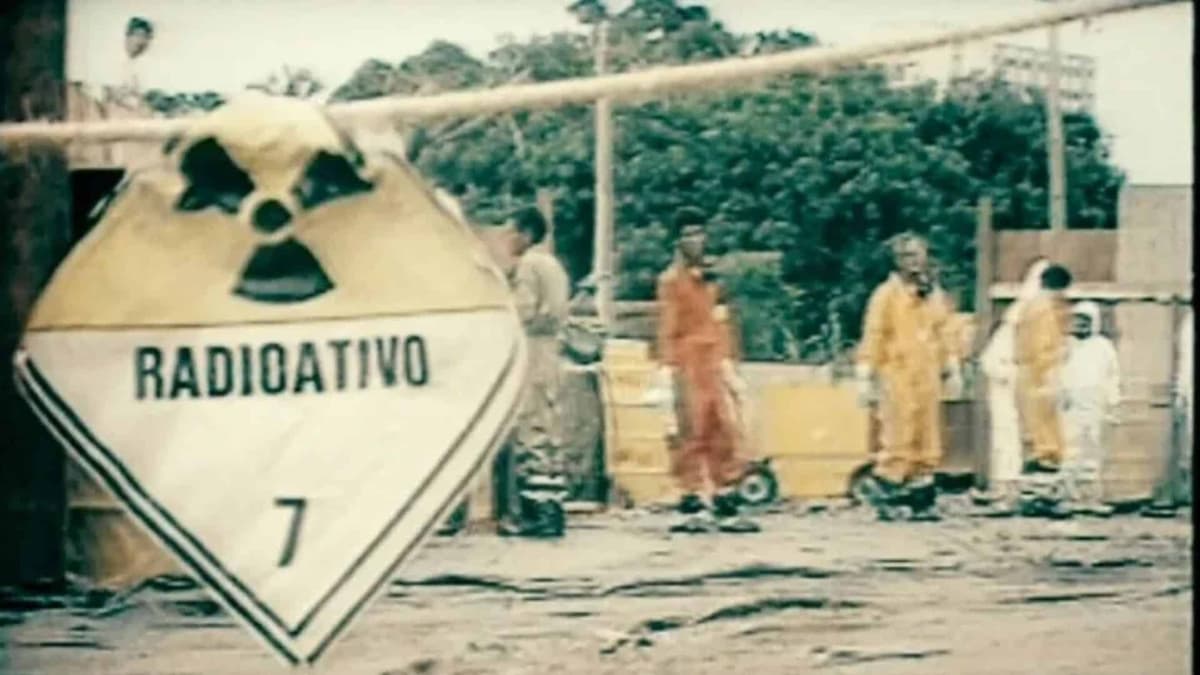
Understanding the two accidents
What happened in Goiânia
In September 1987, an abandoned radiotherapy device was found in a deactivated clinic. When dismantled by scavengers, it released a capsule containing Cesium-137—a highly radioactive material unknown to those who handled it.
The blue glow emitted by the material sparked curiosity and led to its spread among residents. Without any protection, dozens of people came into direct contact with the substance.
A radiological accident
The Goiânia case is classified as a radiological accident, meaning it does not involve a nuclear chain reaction. It is the improper exposure to an isolated radioactive source, generally used in medical or industrial contexts.
Despite its severity, the contamination was relatively localized, mainly affecting specific areas of the city.
What happened in Chernobyl
The Chernobyl disaster occurred in April 1986, when a nuclear reactor exploded during a poorly conducted safety test. The accident released an enormous amount of radioactive material into the atmosphere, affecting several European countries.
A nuclear disaster
Unlike Goiânia, Chernobyl was a nuclear accident. This means it involved the failure of an operating reactor, with massive release of elements such as uranium and plutonium.
The scale of the disaster was global, with environmental and human consequences that persist to this day.
International classification: severity levels
The INES Scale
The International Atomic Energy Agency uses the International Nuclear Event Scale (INES) to classify accidents.
Direct comparison
Goiânia (Cesium-137): level 5
Chernobyl: level 7 (maximum on the scale)
This difference highlights the chasm between the two events in terms of impact and severity.
Scale and extent of contamination
An urban tragedy
The accident in Goiânia directly affected approximately 249 people, with more than 100,000 undergoing radiological screening. Four deaths occurred in the following weeks, including the girl Leide das Neves Ferreira.
The contamination remained restricted to specific areas, allowing for relatively effective decontamination actions.
A global catastrophe
In Chernobyl, radiation spread thousands of kilometers away. Entire regions were evacuated, including the city of Pripyat, which remains uninhabited to this day.
It is estimated that millions of people were exposed, directly or indirectly, to radiation.
Nature of radioactive materials
Cesium-137
Cesium-137 is a byproduct of nuclear fission, frequently used in medical equipment.
Main characteristics
Half-life of approximately 30 years
Emits gamma radiation
Can be safely encapsulated when stored correctly
This relatively "short" half-life contributed to the gradual recovery of areas affected in Goiânia.
The Chernobyl material
The disaster involved elements such as uranium and other highly dangerous fission products.